


Loading lessons…
Loading lessons…
Curated lessons across 8 learning paths — from first concepts to trial summaries and practical protocols. Pick your level, follow the curriculum, and build real understanding.
Where are you starting?
Choose a learning path below or search the library. Progress saves in your browser.
Prefer timeline chaos? Peptide X Quiz · Literacy certify
Pick a track — progress rings update as you complete lessons.
19 lessons
 14m
On October 28, 2026, HHS said it will not take enforcement action against qualifying 503A compounding for six peptides while FDA rulemaking continues. That is not FDA approval and not a bulks-list addition. This explainer maps the policy in plain language.
 9m
Lilly has sued 11 retatrutide sellers, FDA has sent warning letters, and Australia's regulator found a 'retatrutide' vial full of semaglutide. Here's the timeline and what it means if you're considering retatrutide.
 7m
The panel backed six peptide nominations but not Emideltide. Here is why evidence and identity questions mattered, and what the result means for people following sleep peptides.
 7m
MOTS-c now has a favorable advisory recommendation. It still does not have FDA drug approval or an open 503A compounding path.
 7m
PCAC recommended BPC-157, KPV, TB-500, MOTS-c, Semax, and Epitalon for 503A compounding. The unresolved fight is what happens while FDA completes rulemaking.
 7m
The favorable Semax vote moved its compounding nomination forward, but the narrow result exposed unresolved questions about evidence, characterization, and US clinical use.
 9m
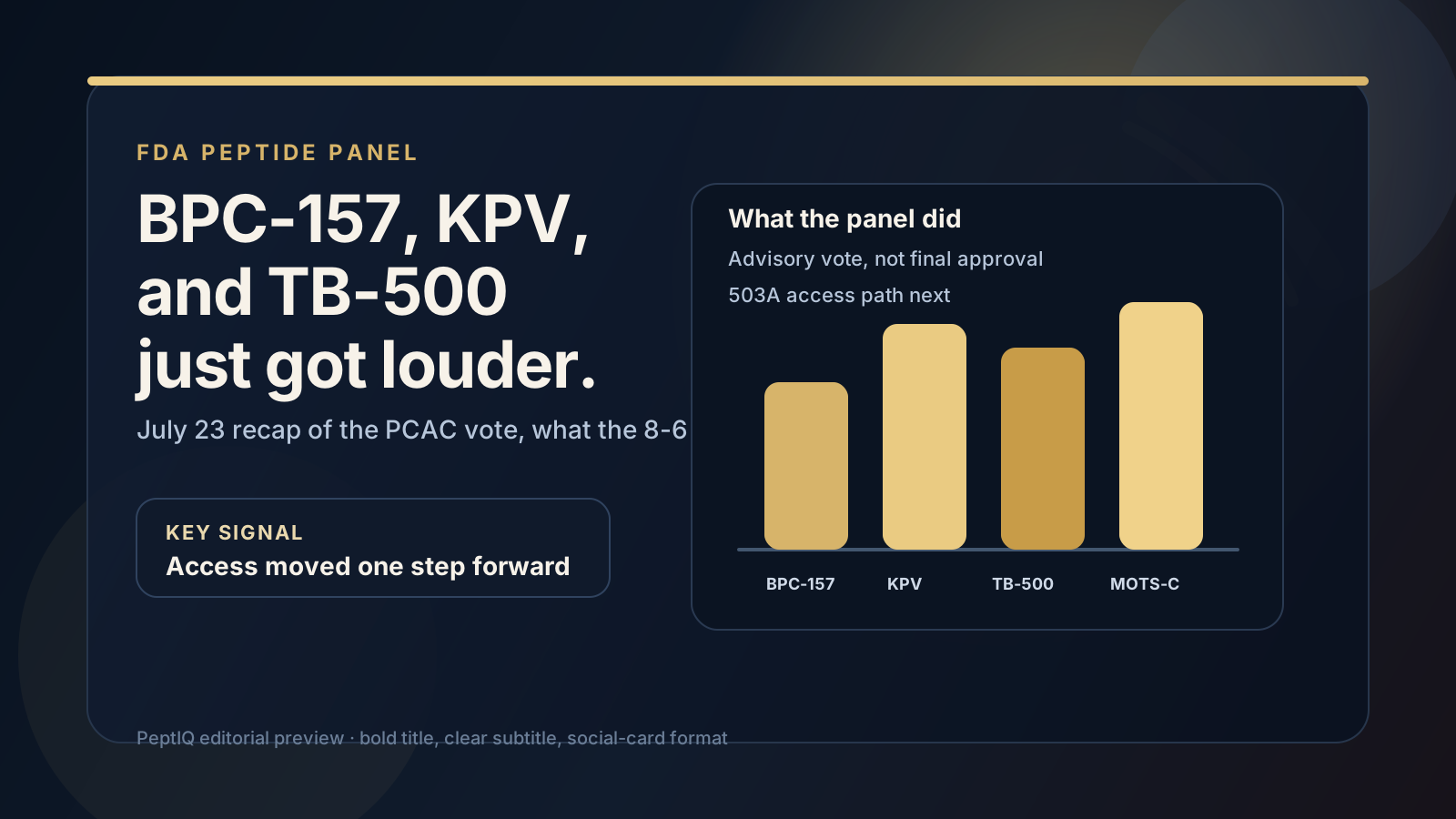
The FDA's peptide panel made its first moves on BPC-157, KPV, and TB-500. The vote matters, but the real story is what it changes next and what still has to happen before compounding pharmacies see any relief.
 8m
The July 2026 FDA peptide review is important, but it is not an approval event. Here is how to track the meeting, sourcing changes, and protocol decisions without confusing policy movement with clinical proof.
 8m
The FDA's April 2026 announcement removed 12 peptides from Category 2 restrictions — the biggest regulatory shift in years. BPC-157, TB-500, MOTS-C, GHK-Cu, and Semax are among those affected. Here's what it actually means for your access.
 9m
After years of FDA crackdowns on research peptides, a significant regulatory reversal in 2026 has changed the landscape for BPC-157, TB-500, and MOTS-C. Here's what actually happened and what it means for you.
 9m
No drug containing GHK-Cu is FDA approved. Topical copper peptides are cosmetics, non-injectable GHK-Cu is still under FDA evaluation, and GHK-Cu is not on the October 2026 HHS peptide list.
 9m
For years, GLP-1 therapy meant a weekly injection. The FDA just changed that. Foundayo is the first oral GLP-1 approved for weight management, and the implications for the peptide community go far beyond convenience.
 9m
The FDA's April 15, 2026 reclassification of 12 research peptides marks the most significant regulatory shift in the space since the 2023 compounding crackdown. Here's a breakdown of the affected compounds, the new compliance landscape, and how to think about your protocol going forward.
 10m
An FDA advisory panel scheduled for July 2026 could reshape access to 12 peptides — including BPC-157, MOTS-C, and GHK-Cu. Here's what's on the table, what reclassification would mean in practice, and how to prepare for either outcome.
 10m
Epitalon is a lab-made four-amino-acid peptide based on a pineal gland extract. It lengthens telomeres in cell studies, but human evidence is small and old. It is not FDA approved, and since October 2026 it is one of six peptides in an HHS compounding policy.
 11m
IGF-1 LR3 is a lab-modified copy of the IGF-1 hormone, built in 1992 as a research reagent. A 2026 review places it in the tier with no peer-reviewed human studies at all. It is not FDA approved, is regulated as a biologic rather than a peptide, and is prohibited in sport.
 9m
After years of regulatory limbo, BPC-157 is at the center of a major policy battle. The RFK Jr.-led HHS push to reclassify it as Category 1 could restore legal compounding access—or the FDA could dig in. Here's where things stand.
 9m
A potential FDA regulatory shift on 14 compounded peptides — including BPC-157 and TB-500 — could reshape who gets access to peptide therapy and how. Here's what the current signals actually mean.
 9m
MOTS-c is a 16-amino-acid peptide encoded in mitochondrial DNA. It has strong mouse data, one recruiting placebo-controlled human trial and no FDA approval. In October 2026 HHS added it to an interim compounding policy.
Also available at /blog for legacy links.