


Loading lessons…
Loading lessons…
Curated lessons across 8 learning paths — from first concepts to trial summaries and practical protocols. Pick your level, follow the curriculum, and build real understanding.
Where are you starting?
Choose a learning path below or search the library. Progress saves in your browser.
Prefer timeline chaos? Peptide X Quiz · Literacy certify
Pick a track — progress rings update as you complete lessons.
67 lessons
 12m
ACE-031 is a discontinued myostatin-trapping drug sold online as a muscle builder. Its human trials were real, and so was the reason they stopped: a bleeding and blood-vessel signal traced to the one ligand the drug was never meant to catch. When an anti-doping laboratory tested fourteen products sold under the name, none of them contained ACE-031 at all.
 11m
GHRP-6 is the original growth hormone-releasing peptide, a synthetic hexapeptide from 1984 that works on the ghrelin receptor. It reliably raises growth hormone in people, which is why endocrinologists used it as a diagnostic test. What it has never had is a trial showing it improves body composition, recovery or any clinical outcome.
 14m
Searchers often type "CBL-514 peptide," but Caliway's drug is a first-in-class small molecule in global Phase 3 for abdominal subcutaneous fat. Here is what trials have reported — and what is still unknown.
 11m
Follistatin 344 is sold online as a muscle-building peptide. It is not a peptide: at 344 amino acids it is a protein. No published human trial has tested the injected product, the only follistatin-based drug to reach randomized trials grew muscle without improving function, and lab testing of black-market vials found most of them were not what the label said.
 10m
Gonadorelin is a lab-made copy of GnRH, the brain hormone that starts the testosterone and fertility chain. Both US human products were discontinued, current US labels are for cattle, and no published trial has tested it for protecting fertility on testosterone therapy.
 11m
On November 9, 2026, FDA required a class-wide warning about NAION, a rare optic nerve condition that can cause sudden vision loss. The risk is real enough to label, small in absolute terms, and still debated. Here is the evidence, drug by drug.
10mTwo antibodies that block the myostatin/activin pathway are being tested alongside GLP-1 drugs to protect lean mass. Bimagrumab's phase 2 BELIEVE trial is published in Nature Medicine. Apitegromab is FDA-approved, but only for spinal muscular atrophy. Neither is a peptide or a pill.
8mSetmelanotide is a melanocortin-4 receptor agonist peptide, approved only for specific rare causes of obesity. In 2026 its label expanded to acquired hypothalamic obesity after the TRANSCEND phase 3 trial. Here's how it differs from GLP-1 drugs and what the label warns about.
 14m
On October 28, 2026, HHS said it will not take enforcement action against qualifying 503A compounding for six peptides while FDA rulemaking continues. That is not FDA approval and not a bulks-list addition. This explainer maps the policy in plain language.
 9m
NAD+ is essential to cells. That does not make every NAD+ treatment effective. A practical guide to IV claims, oral precursors and what human studies actually measured.
 9m
SLU-PP-332 is a synthetic small molecule that activates estrogen-related receptors linked to exercise biology. Here is what the mouse studies actually show, and what is still unknown in humans.
 9m
GHK-Cu is a small copper-binding peptide with decades of lab research and a thin human record. Here's what it is, why topical and injectable use are different questions, and where FDA stands in 2026.
 9m
Retatrutide is Lilly's investigational GIP, GLP-1 and glucagon receptor agonist. Understand the trial findings, how it differs from approved medicines, and why it is not available by prescription.
7mPatients ask about BPC-157 after extractions and implants. The dental literature is one rat periodontitis model, one rat oral-injury model, and three uncontrolled human cases. Here is each one.
8mEnamel matrix derivative and rhPDGF-BB are FDA-approved devices with decades of trials. BPC-157 and TB-500 have one rat study each in periodontitis. Here is the whole picture, with sources.
9mMost peptide stigma is not a single hazard. It is three different risks that clinics mash together. Separate them and the conversation with counsel, pharmacy, and medical directors gets shorter.
8mIf your team cannot state the regulatory status of each compound in one clean sentence, the menu is not ready. Here is the three-band model clinics use before counsel finishes the memo.
7mVendor PDFs are not primary sources. Here is the order clinics should read FDA and state board pages so status sheets survive the first counsel review.
12mA goal-by-goal map of the peptides people ask about most, scored on human evidence and regulatory status. The only ones with strong evidence are approved drugs; most of the rest are animal data. No vendors, no dosing.
9mA GLP-1 program is a months-long titration that happens at the patient's kitchen table. This guide covers the operational pieces clinics need: adherence against the titration schedule, side-effect logs the prescriber reads, refill timing, check-in cadence, and the compounded-product issues FDA has flagged.
 11m
No peptide is FDA-approved for building muscle in healthy adults. Here is what the human trials actually measured for growth hormone secretagogues, IGF-1 analogs, MOTS-c and the GLP-1 drugs, where each sits on the evidence ladder, and what regulators and anti-doping rules say.
8mPT-141 is the research name for bremelanotide, FDA-approved in 2019 as Vyleesi for low sexual desire in premenopausal women. Here's how it works, what the trials and label say about side effects, who it isn't approved for, and why research-grade PT-141 isn't the same product.
10mPeptides are short chains of amino acids that act as messengers in the body. Some are FDA-approved medicines like insulin and the GLP-1 drugs. Many sold online are unapproved research chemicals. Here's the plain-language version.
9mTirzepatide is the dual GIP/GLP-1 receptor agonist behind Mounjaro (type 2 diabetes) and Zepbound (weight management, sleep apnea). Here's what it is, what the trials showed, how it compares with semaglutide and retatrutide, and how to get evaluated by a licensed clinician.
6mARA-290 (cibinetide) explained: the EPO-derived peptide studied for small fiber neuropathy, what Phase 2 trials found, side effects, and FDA status.
 10m
SS-31 is elamipretide, a mitochondria-targeting peptide. FDA approved it in 2025 as Forzinity for one rare disease. Trials in other conditions mostly missed their main goals, and research vials are not the approved drug.
6mAdamax is marketed as a modified Semax. Semax has decades of mostly Russian research. Adamax has essentially none in the published literature. Here's the honest comparison.
9mLilly has sued 11 retatrutide sellers, FDA has sent warning letters, and Australia's regulator found a 'retatrutide' vial full of semaglutide. Here's the timeline and what it means if you're considering retatrutide.
5mKPV is a three-amino-acid fragment of α-MSH studied for inflammation, mostly in the gut and mostly in mice. Here's what's known, what's claimed and what's missing.
6mTesamorelin is the only FDA-approved GHRH analog. It targets deep belly (visceral) fat in a specific population. Here's what the trials actually found, including the muscle question.
 7m
Novo Nordisk submitted CagriSema in December 2025. The fixed-dose amylin and GLP-1 combination remains investigational while FDA reviews the application.
 7m
The panel backed six peptide nominations but not Emideltide. Here is why evidence and identity questions mattered, and what the result means for people following sleep peptides.
 7m
Epitalon received a narrow advisory vote for 503A compounding in insomnia. That vote is not FDA approval, immediate access, or validation of longevity claims.
 7m
MOTS-c now has a favorable advisory recommendation. It still does not have FDA drug approval or an open 503A compounding path.
 7m
PCAC recommended BPC-157, KPV, TB-500, MOTS-c, Semax, and Epitalon for 503A compounding. The unresolved fight is what happens while FDA completes rulemaking.
 7m
Positive TRIUMPH-2 and TRIUMPH-3 results did not produce a 2026 filing. Lilly says the remaining work is in the CMC and manufacturing package.
 7m
The favorable Semax vote moved its compounding nomination forward, but the narrow result exposed unresolved questions about evidence, characterization, and US clinical use.
 8m
The loudest peptide stories are moving at different speeds. PCAC recommendations await FDA action, oral GLP-1 access is real, and the next obesity programs still have filing or review milestones ahead.
 7m
TB-500 received a favorable advisory recommendation for wound healing. FDA action still has to follow, and the product sold online may not match the substance the committee reviewed.
 7m
A favorable advisory vote is not permission to prescribe or compound. Here is the practical standard telehealth clinics should use after the 2026 PCAC meeting.
 9m
Tesamorelin is one of the few GHRH analogs with an FDA-labeled daily milligram figure. That number belongs to a specific product and indication. It does not automatically travel to an unlabeled vial.
 9m
Retatrutide keeps stacking strong data, and the latest trial update sharpens the path toward an FDA submission. The bigger story is not just weight loss. It is how the triple-agonist profile may change what obesity medicine expects from a next-wave therapy.
 8m
The regulatory story matters because it changes what you can trust, what you should track, and why supply chain quality now sits beside mechanism in the BPC-157 debate.
 9m
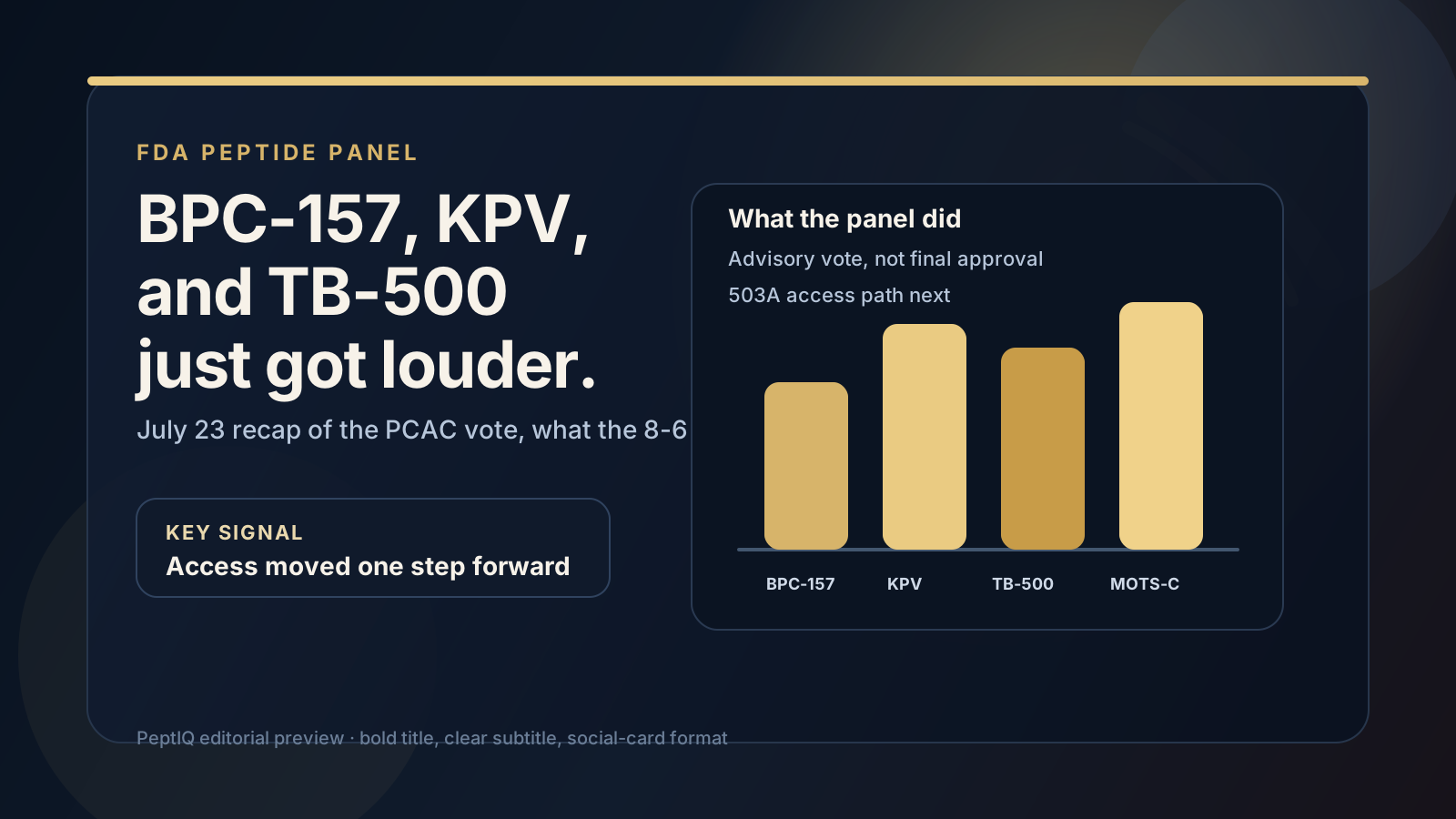
The FDA's peptide panel made its first moves on BPC-157, KPV, and TB-500. The vote matters, but the real story is what it changes next and what still has to happen before compounding pharmacies see any relief.
 9m
MOTS-C sits at the intersection of mitochondrial signaling, metabolism, and longevity. July 2026 put it back in the spotlight for a reason.
 8m
Regulation does not settle the peptide debate by itself. It forces clearer questions about sourcing, safety, evidence, and who is responsible when claims move faster than data.
 8m
The July 2026 FDA peptide review is important, but it is not an approval event. Here is how to track the meeting, sourcing changes, and protocol decisions without confusing policy movement with clinical proof.
 7m
The biggest peptide trend in 2026 may not be a molecule. It may be oversight, sourcing quality, and the ability to separate evidence from marketing.
 7m
AMA and FDA updates make one thing clear: peptide interest is moving faster than human evidence, dosing standards, and product-quality controls. Use this checklist before trusting a vial.
 8m
The FDA's April 2026 announcement removed 12 peptides from Category 2 restrictions — the biggest regulatory shift in years. BPC-157, TB-500, MOTS-C, GHK-Cu, and Semax are among those affected. Here's what it actually means for your access.
 8m
Seven FDA warning letters in April 2026 show regulators are paying closer attention to online peptide sellers, especially research-use-only marketing that looks like consumer health claims.
 9m
After years of FDA crackdowns on research peptides, a significant regulatory reversal in 2026 has changed the landscape for BPC-157, TB-500, and MOTS-C. Here's what actually happened and what it means for you.
 8m
Confused about peptide compounding categories? This guide breaks down 503a compounding pharmacies, 503b outsourcing facilities, and why “research use only” is not a consumer pathway PeptIQ endorses.
 9m
No drug containing GHK-Cu is FDA approved. Topical copper peptides are cosmetics, non-injectable GHK-Cu is still under FDA evaluation, and GHK-Cu is not on the October 2026 HHS peptide list.
 9m
For years, GLP-1 therapy meant a weekly injection. The FDA just changed that. Foundayo is the first oral GLP-1 approved for weight management, and the implications for the peptide community go far beyond convenience.
 9m
The FDA's April 15, 2026 reclassification of 12 research peptides marks the most significant regulatory shift in the space since the 2023 compounding crackdown. Here's a breakdown of the affected compounds, the new compliance landscape, and how to think about your protocol going forward.
 10m
An FDA advisory panel scheduled for July 2026 could reshape access to 12 peptides — including BPC-157, MOTS-C, and GHK-Cu. Here's what's on the table, what reclassification would mean in practice, and how to prepare for either outcome.
 10m
KLOW is a vendor name for a four-peptide blend: BPC-157, TB-500, GHK-Cu and KPV in one vial. Here's what each ingredient is, what the research actually covers, how KLOW differs from GLOW and Wolverine, and where it stands with FDA.
 10m
Epitalon is a lab-made four-amino-acid peptide based on a pineal gland extract. It lengthens telomeres in cell studies, but human evidence is small and old. It is not FDA approved, and since October 2026 it is one of six peptides in an HHS compounding policy.
 9m
Two products share the CJC-1295 name. Learn what the Drug Affinity Complex changes, what the 2006 human studies actually measured, and why the no-DAC version has far less published evidence.
 11m
IGF-1 LR3 is a lab-modified copy of the IGF-1 hormone, built in 1992 as a research reagent. A 2026 review places it in the tier with no peer-reviewed human studies at all. It is not FDA approved, is regulated as a biologic rather than a peptide, and is prohibited in sport.
 9m
Tesamorelin is an FDA-approved GHRH analog with clinical trials proving 15–20% visceral fat reduction. Here's the full science, dosing guide, and what the latest research reveals about its longevity applications.
 9m
After years of regulatory limbo, BPC-157 is at the center of a major policy battle. The RFK Jr.-led HHS push to reclassify it as Category 1 could restore legal compounding access—or the FDA could dig in. Here's where things stand.
 9m
A potential FDA regulatory shift on 14 compounded peptides — including BPC-157 and TB-500 — could reshape who gets access to peptide therapy and how. Here's what the current signals actually mean.
 9m
MOTS-c is a 16-amino-acid peptide encoded in mitochondrial DNA. It has strong mouse data, one recruiting placebo-controlled human trial and no FDA approval. In October 2026 HHS added it to an interim compounding policy.
 11m
Melanotan 2 is a synthetic hormone analogue from a University of Arizona tanning program. It darkens skin in people, and it also causes erections, nausea and appetite changes. Its relatives became approved drugs. It never did, and the case-report record explains why regulators keep warning about it.
 8m
Discover Tesamorelin, the only FDA-approved GHRH peptide, specifically indicated for reducing visceral fat.
Also available at /blog for legacy links.